Treatments & lens options

One operation, many decisions

Cataract surgery and refractive lens exchange explained plainly — including the option of not operating at all.

Cataract surgery & refractive lens exchange

These are essentially the same operation. After the age of 40 the natural lens of the eye gradually stiffens — this is presbyopia, the reason reading glasses become necessary — and eventually it clouds over and becomes a cataract.

In both procedures the natural lens is removed and replaced with an artificial intraocular lens (IOL). When the lens has already clouded, it is called cataract surgery. When a clear but stiffened lens is replaced earlier — usually to reduce dependence on glasses — it is called refractive lens exchange (RLE), also known as natural lens replacement.

The operation is done under anaesthetic drops and typically takes about 7 minutes in Mr Desai's care. Most patients see well remarkably quickly: in his audit, around 95% met the driving vision standard by the next morning.

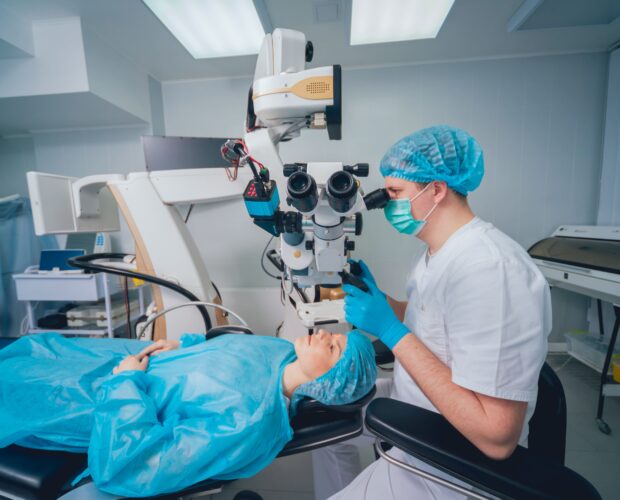
Cataract surgery being performed under an operating microscope
Cataract surgery under the operating microscope

Before choosing surgery: your alternatives

Mr Desai wants every patient to reflect on all the options. Not operating is a valid choice — surgery should only go ahead when its benefits genuinely outweigh its risks for you.

Spectacles

The simplest and safest option. Modern varifocals correct distance, intermediate and near vision with no surgical risk at all.

Contact lenses

Effective for many, including multifocal designs — though comfort and handling can become harder with age and dry eyes.

Monovision with contact lenses

One eye corrected for distance and one for near. A useful, fully reversible way to trial monovision before committing to it surgically.

Laser vision correction

Reshapes the cornea rather than replacing the lens. It does not treat cataract or presbyopia's progression, but suits some patients better.

In order of increasing risk and benefit

Lens (IOL) options

Every artificial lens is a compromise. "There are no perfect solutions, and all solutions have their own disadvantages." The options below are listed from lowest risk to highest — and, broadly, higher risk buys greater freedom from glasses.

Option 1

Monofocal

The sharpest possible image at a single distance — usually set for distance vision. Glasses are needed for near and intermediate tasks such as reading and computer work. The standard NHS choice, with the most predictable quality of vision.

Option 2 — Mr Desai's usual recommendation

Enhanced monofocal

Sharp distance vision plus useful intermediate vision, with very little added risk. Around 60% of patients get reliable intermediate vision and around 37% even get good near vision. Mr Desai's preferred recommendation for most private patients.

Option 3

Monovision with enhanced monofocal IOLs

One eye set for distance and the other slightly for near (about −0.75 apart). A good compromise for patients who want more spectacle freedom but do not want the optical side-effects of multifocal lenses.

Option 4

Multifocal IOLs

The most reliable route to spectacle independence — distance, intermediate and near — but with the highest risk of glare, haloes and quality-of-vision issues. Diffractive and refractive (SBL bifocal) designs are available, with toric versions to correct astigmatism.

Additional procedures

YAG capsulotomy

A quick, painless laser procedure to clear the clouding of the lens capsule (posterior capsular opacity) that around 20% of patients develop within 5 years of surgery.

IOL exchange

Removing and replacing an implanted lens — most often for multifocal intolerance. A complex revision procedure: Mr Desai has performed over 350 IOL exchanges in the past 3 years, one of few UK surgeons undertaking them.

An honest word on "spectacle freedom"

Most people are left with a small residual refractive error after surgery, and around 7% need further correction. There is no perfect solution — the aim is to choose the compromise that suits your eyes, your habits and your tolerance of risk. This is discussed openly at consultation.

Not sure which option fits you?

The right lens depends on your eyes, your lifestyle and your attitude to risk. A consultation settles it — with no obligation to proceed.